
Knowledge
Advantages of High-Voltage Differential Probes and the Limitations of Passive Probes
Using high-voltage differential probes is a routine task for power electronics engineers, but there are many differences between their use and that of standard passive probes. Choosing the correct measurement method is key to ensuring both safety and accuracy.
Three Methods of High Voltage Power Supply Measurement
1. Floating Ground Measurement Method
Directly float the oscilloscope’s ground lead to measure high-voltage signals. This practice is unsafe and inaccurate. Due to the existence of parasitic | 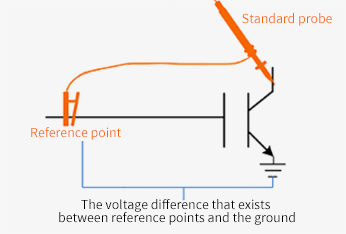 |
2. AB pseudo-differential method.
Use two passive probes to measure the voltage of two points relative to ground separately, and then use the oscilloscope's math function to subtract and obtain the differential value. Although relatively safe, avoiding the risk of direct grounding short | 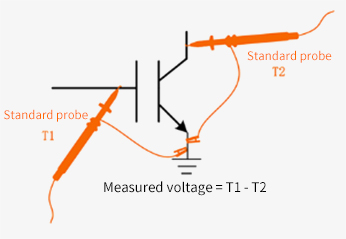 |
3. High-Voltage Differential Probe Measurement Method
Use a dedicated high-voltage differential probe to directly measure the voltage difference between two points. This is currently the safest and most accurate method. The probe features high-voltage isolation and high common-mode rejection design internally, allowing direct measurement of signals with high voltage relative to ground. It is also suitable for differential systems that do not share a common ground (such as CAN bus), avoiding the risk of short circuits caused by improper grounding. | 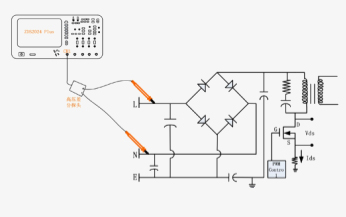 |
4. High-Voltage Differential Probe
The high-voltage differential probe uses a differential input mode and is mainly used in situations where high-voltage floating ground measurements are required. This high-performance high-voltage differential probe features audio-visual alarm functions, a 5MHz bandwidth limit option, and provides better common-mode noise suppression capability. Its bandwidth reaches up to 100MHz, with high input impedance and low input capacitance at the input terminals, allowing accurate and high-speed measurement of differential voltage signals, meeting the needs of most testing systems. | 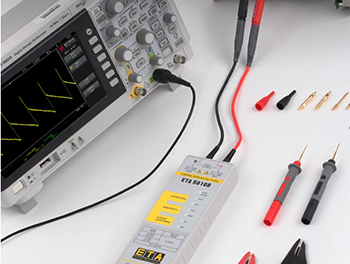 |