
Knowledge
In‑depth actual measurements of high‑ and low‑cost current probes reveal a disparity in parameters that goes well beyond mere differences.
Current probe measured contrast: low-cost and high-end probe waveform gap how much?
In current waveform testing, waveform quality directly affects R&D engineers’ assessment of product performance. A high-quality current probe can more faithfully reconstruct signal variations, minimizing noise, distortion, and response lag; in contrast, a probe with inadequate performance may introduce amplitude errors, obscure fine details, and even lead to misinterpretation of test results.
Next, we will use an oscilloscope to evaluate the waveform performance of two current probes, with a focus on waveform stability, response speed, noise level, and signal fidelity, in order to provide more reliable data for subsequent test‑case selection.
1. Measured Scene and Overall Performance
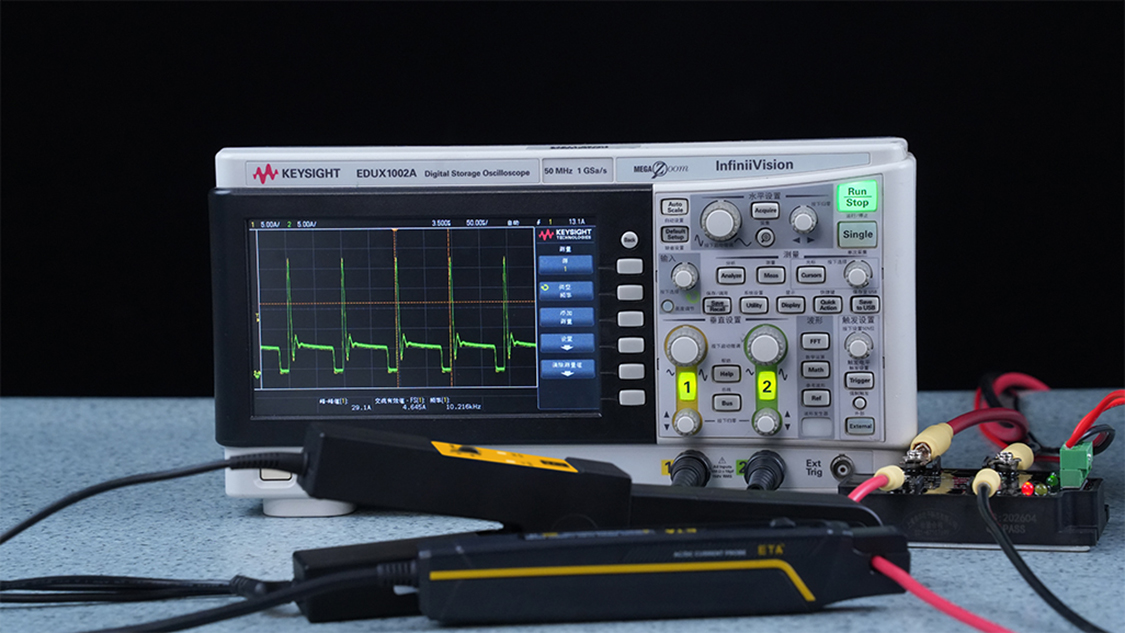
During testing, the waveform differences between the two probes were clearly visible to the naked eye. The low-cost probe ETA5301 exhibits a waveform amplitude significantly lower than that of high-end probes, with insufficient high-frequency response and a sharp increase in measurement error for small currents.
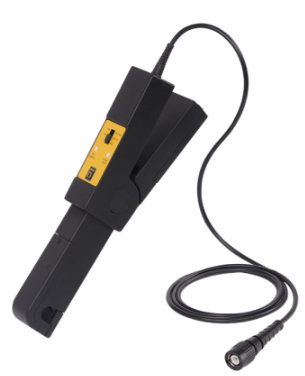
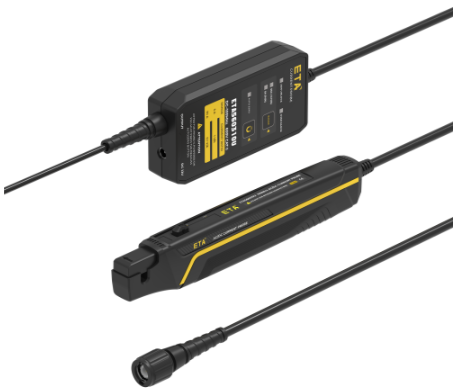
The ETA560310U features a dual-range design (30 A/5 A), allowing you to switch between high-current monitoring and low-current analysis with a single button, while preserving clear and complete waveform details. It uses Hall and transformer collaborative technology, with automatic zero function, effectively suppress baseline drift and electromagnetic interference, test repeatability and stability far more than low-cost products.
2. single-cycle waveform detail reduction
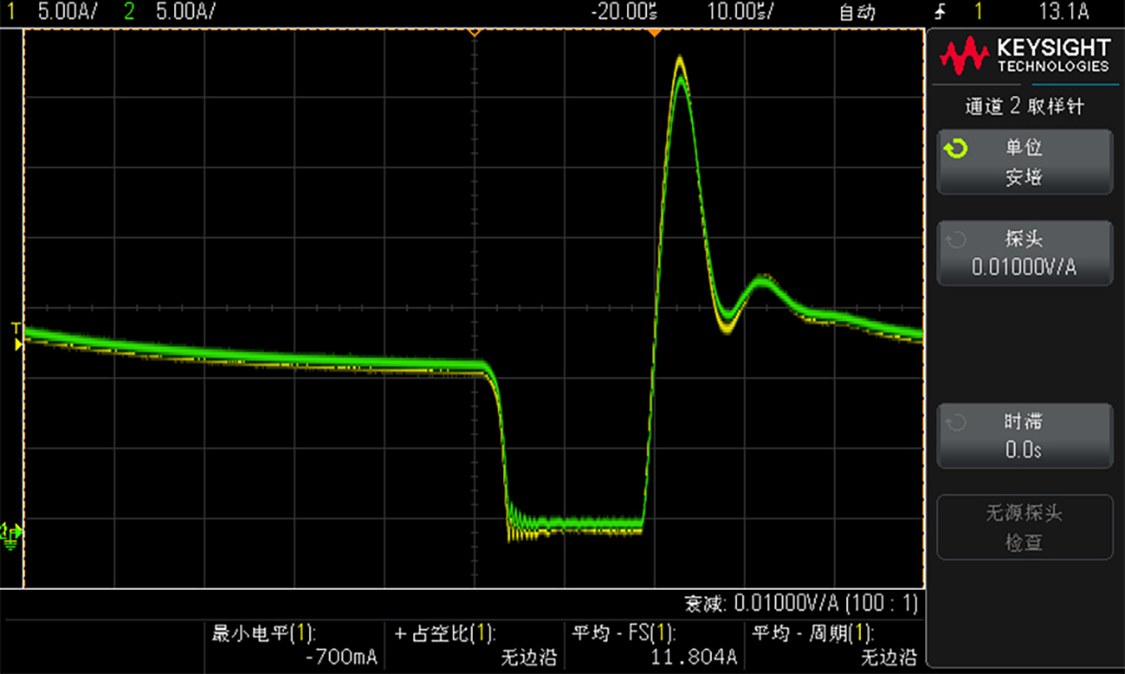
From the single pulse waveform, it can be seen intuitively that the ETA560310U can accurately reproduce the complete form of current rising edge, peak oscillation and falling edge, the signal characteristics are preserved intact, the amplitude measurement accuracy is higher, and the fine circuit analysis can be supported.
3. Comparison of Continuous Waveform Stability
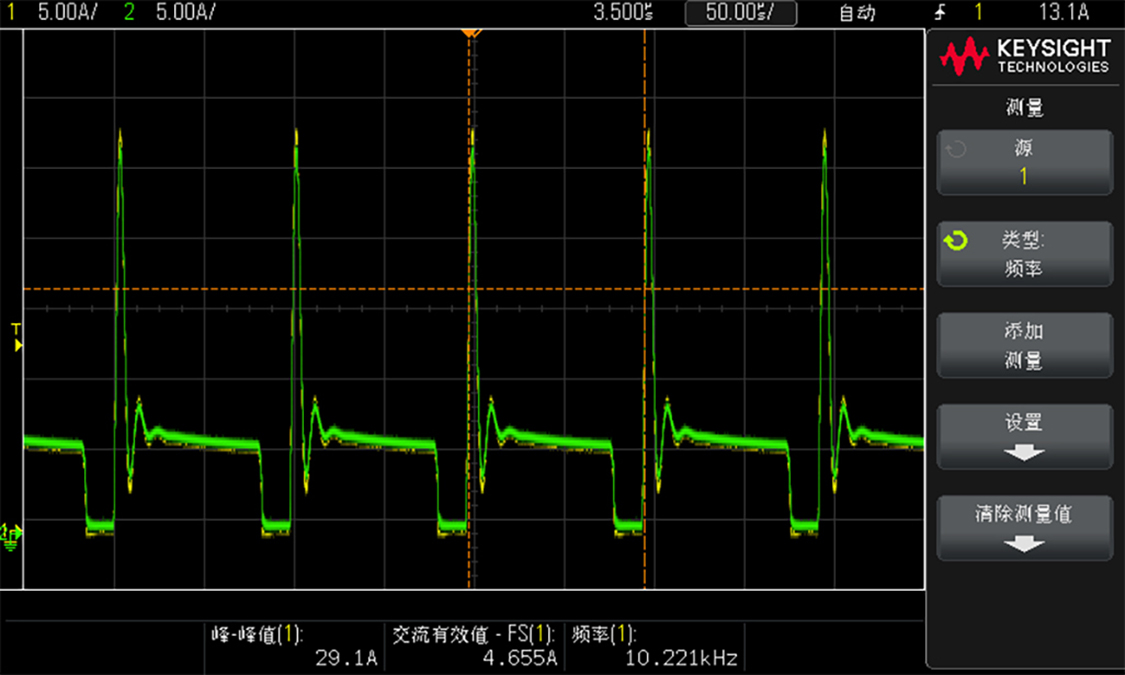
In real-world R&D scenarios, low-cost probes can easily lead to signal misinterpretation, prolong the troubleshooting cycle, and even result in design errors. The ETA560310U can completely retain the signal rising edge, peak oscillation and other key data of each cycle, realize the reliable measurement of "what you see is true", and greatly improve the debugging efficiency.
4. Core Parameter Comparison Table
The following table compares the core parameters and specifications of the two products, which can be used as a reference for selection:
Parameter item | ETA5301 | ETA560310U |
Actual product image |
|
|
Price after coupon | ¥1,280 | ¥7,880 |
Core bandwidth | DC~600KHz(-3dB) | DC~100MHz(-3dB) |
Rated current | 100A(Peak) | 30A(RMS),Supports two range settings: 5A and 30A |
Minimum resolution | 0.1A | 5mA |
Conductor diameter | Φ11.8mm | Φ5mm ( Insulated conductor) |
Range setting | 10A / 100A Two gears | 5A / 30A Two gears |
Interface type | BNC | BNC |
Summary
As a domestically produced premium probe, the ETA560310U from E‑Yong leverages core magnetoelectric sensing technology to strike an optimal balance between precision and cost, delivering superior value compared
to imported counterparts. It uses real waveforms to demonstrate that a truly superior instrument is not judged by its spec sheet, but by the perfect alignment between physical reality and test results.
For R&D teams and laboratories, foregoing the short-term cost savings of low‑cost probes in favor of high‑precision, highly stable current probes is essential to eliminate testing bottlenecks and ensure both R&D efficiency
and product quality through engineering certainty.