
Knowledge
How to Measure DC Current with Current Probe of Oscilloscope
In order to verify whether the power consumption of battery-powered equipment (mobile phones, portable terminals, etc.) meets the design specifications, engineers often need to carry out low-current tests. Conventional current measurement requires disconnecting the loop and connecting the test instrument in series, which is complicated to operate. With clamp-on current probe and oscilloscope, current acquisition can be completed without damaging PCB wiring.
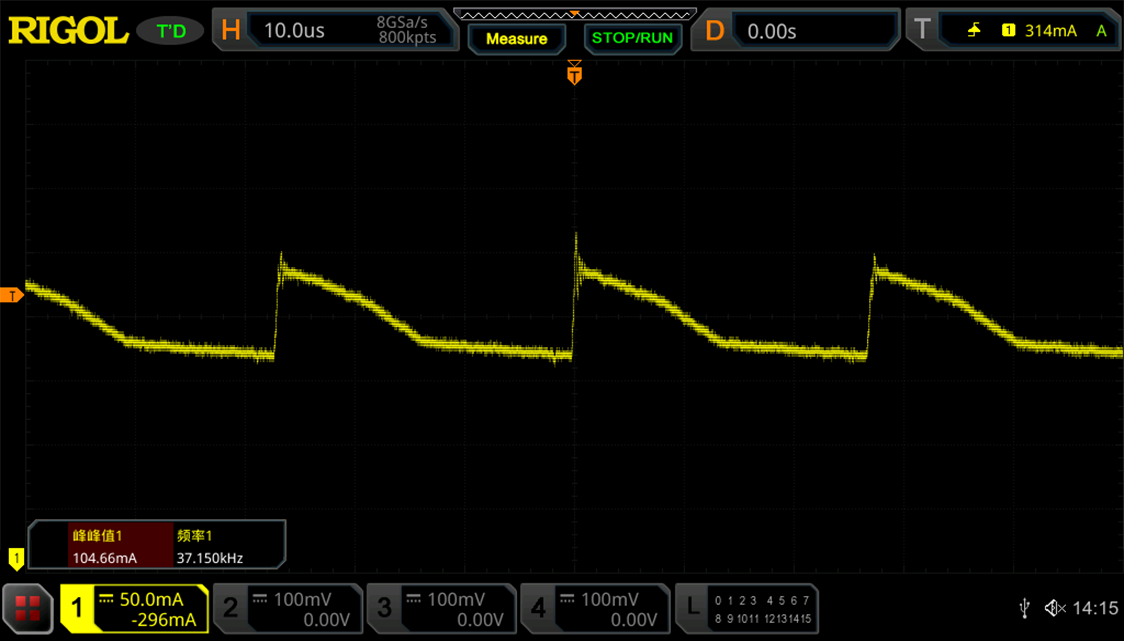
However, the measurement of weak DC current at mA level and below is easily interfered by the background noise of the oscilloscope. This article shares practical debugging tips to help improve the accuracy of DC current measurement in high noise environments.
1. Influence of Oscilloscope Noise on Small Current Test
The lower the amplitude of the current signal, the more prominent the influence of the vertical noise of the oscilloscope itself. All oscilloscopes have inherent vertical noise. When measuring weak signals, system noise will directly reduce measurement accuracy.
The oscilloscope is a broadband test instrument. The higher the bandwidth, the greater the vertical noise. It is recommended to evaluate the noise base of the oscilloscope before the formal test:
- 500MHz bandwidth oscilloscope, when switching to the most sensitive V/grid position, the background noise is about 2mV (peak-to-peak value);
- Under the same bandwidth condition, the greater the acquisition and storage depth, the higher the background noise;
- Take Keysight N2783B(100MHz AC/DC current probe) as an example: the lower limit of range is 5mA, the accuracy is about 3%, and the conversion ratio is 0.1V/A; When measuring small currents within 20mA, oscilloscope 2mVpp background noise is often the main error source.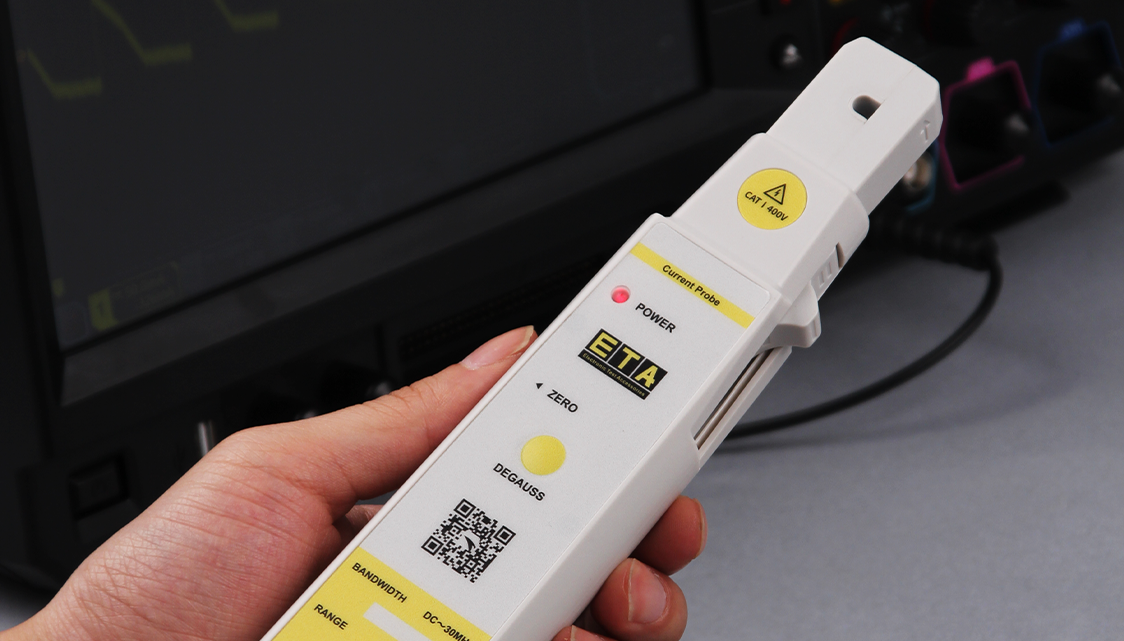
2. Three Common Schemes to Reduce the Intrinsic Noise of Oscilloscopes
Digital oscilloscope built-in multiple noise reduction function, measurement of weak DC/low frequency current priority combination:
1. bandwidth limiting filter
Most oscilloscopes support hardware/software bandwidth limiting filters, which filter out-of-band high-frequency noise after being turned on, compress noise bandwidth, improve vertical resolution, and support on-demand switching.
2. High resolution acquisition mode
The vertical resolution of the normal acquisition mode is 8bit; the high-resolution mode can be increased to 12bit to suppress vertical noise.
This mode is suitable for slow time base settings (Time/Div), the principle is to do a weighted average of multi-point samples near the same trigger point.
3. Waveform Averaging Mode
Suitable for DC signal, periodic current signal, multiple waveform acquisition and continuous statistical average, effectively suppress random noise.
Contrast tips:
High resolution mode: reduced bandwidth and sampling rate;
Average mode: does not reduce the bandwidth, but the waveform refresh speed becomes slower; the higher the average number of settings, the more obvious the noise reduction effect.
3. Practical Operation Skills for Improving Measurement Accuracy and Sensitivity of Current Probe
Clamp-on AC/DC current probe can directly measure AC/DC by clamping current-carrying conductor without disconnection. Typical models: Keysight N2780A series and 1147B. The following two operations are the key to low current testing:
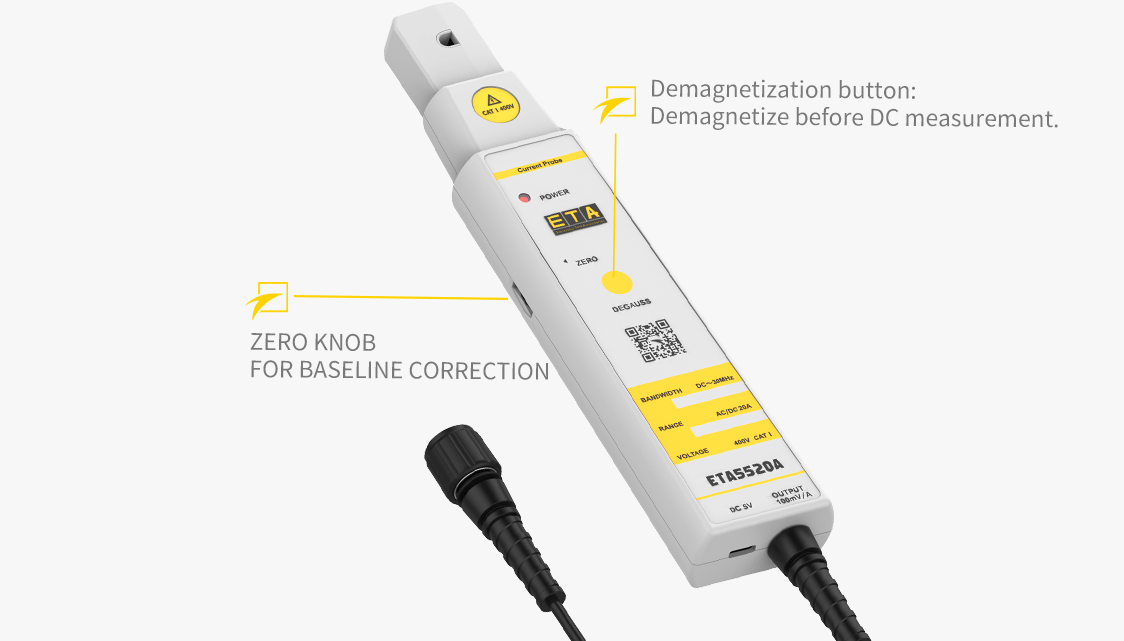
1. Probe degaussing (demagnetization) DC zeroing correction
The remanence of the magnetic core will introduce a fixed bias voltage, which directly causes the DC measurement error, especially the low current test error.
Operation steps:
· Disengage the probe jaws from all wires, and close the latches;
· Press the degaussing button of probe [DEMAG/DEGAUSS] to complete degaussing;
· Use the zero knob to correct the voltage offset and temperature drift.
Trigger degaussing scenario: after the probe is powered on/off and has input a large current exceeding the range, it must be degaussing and zeroing.
2. Multi-turn winding, improve probe sensitivity
The current probe detects the magnetic field around the wire, and the output voltage is proportional to the ampere-turn.
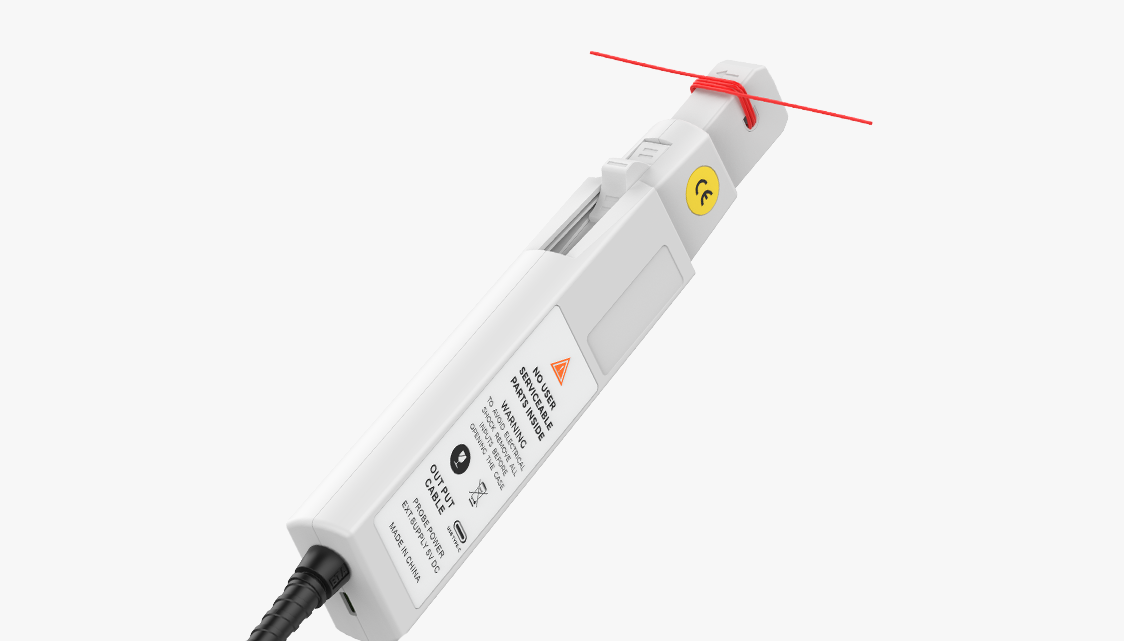
When measuring DC or low-frequency weak current, the measured wire can be wound N times in the jaw, which is equivalent to amplify the magnetic field signal and increase the sensitivity by N times.
Calculation formula:
True current = oscilloscope reading ÷ number of turns
Example: The conductor is wound for 5 turns, the oscilloscope reading 25mA → actual current = 25mA ÷ 5 = 5mA, and the sensitivity is increased by 5 times.
4. Summary
Clamp-on current probe oscilloscope solution; its main advantage is non-invasive measurement, eliminating the need to break the circuit. However, in the milliampere-level weak DC scene, the oscilloscope broadband noise, probe core remanence, DC bias will bring obvious errors.
The combination of bandwidth limitation, high-resolution acquisition, waveform average noise reduction, with probe degaussing and zeroing, multi-turn sensitization method can significantly suppress noise and improve the stability and accuracy of weak DC current measurement.