
Knowledge
The influence of the length of the ground wire of the passive probe on the noise of high-speed switching, which scenes cannot use spring ground?
When testing switch-mode power supplies, GaN/SiC converters, and high-speed digital circuits, many engineers commonly encounter a shared issue: the oscilloscope captures switching waveforms with severe ringing and numerous glitches. After repeatedly troubleshooting the hardware, it became clear that the anomaly was not caused by the circuit itself, but by an improper grounding connection on the passive probe.
Ground springs (spring probes or ground rings) are commonly used instead of long alligator‑clip leads for high‑speed measurements, but many sources do not clearly explain how the length of the ground lead affects high‑speed switching noise. Moreover, ground springs are not a universal solution and are unsuitable for many applications.
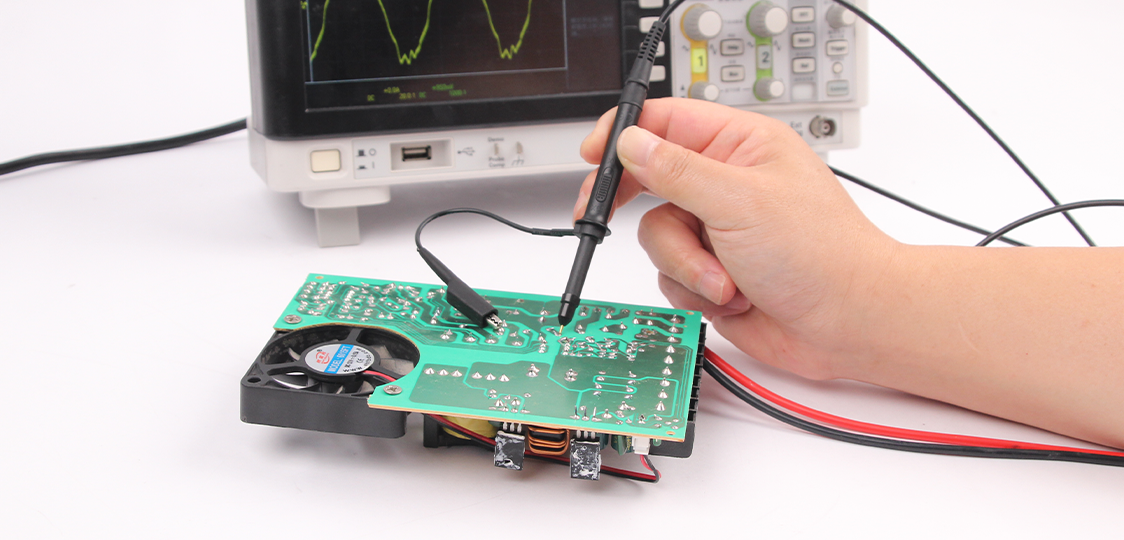
一、The longer the ground lead, the greater the measurement error of high-speed switching noise.
The ground wire of the passive probe itself has parasitic inductance. The core rule is that the longer the ground wire, the greater the parasitic inductance, and the measurement loop area of the probe increases.
In the probe equivalent model, the ground wire inductance L and the probe input capacitance Cin form an LC resonant circuit. The switching edge dv/dt of GaN and SiC devices is extremely high, and the edge contains a large number of high-frequency harmonics, which are easy to stimulate LC resonance. The overshoot and attenuation ringing seen on the oscilloscope are many pseudo noises brought by measurement and are not real waveforms on the circuit board.
At the same time, the large-area measurement loop is equivalent to the receiving antenna, which will pick up the alternating magnetic field formed by the switch di/dt, the clock radiation on the board and the power frequency interference, which are superimposed on the waveform, showing random burrs, baseline drift and false height of the power ripple measurement reading.
- Crocodile clip long line (about 10~15cm): large parasitic inductance, low resonant frequency, only suitable for rough observation of DC and low frequency slow signals;
- Grounding spring: the maximum compression of the ground loop, parasitic inductance is very low, can give full play to the probe nominal bandwidth, restore the low-voltage switch node, power supply noise real state, is the first choice for low-voltage high-speed switch test.
Simply put, the length of the ground wire is the key variable in the high-speed switching test. The shorter the ground wire, the less additional noise introduced by the measurement, and the higher the waveform reliability.
二、When is the application scenario of spring land preferred?
The grounding spring is assembled on the probe head, the signal measuring point is close to the reference ground, and the loop is extremely small. It is the standard configuration for high-speed testing:
DC-DC, LLC, GaN power MOS transistor switch node waveform test;
mV Observation of output ripple and low noise in power supplies;
Nanosecond fast edge pulse, high speed digital signal acquisition;
Bandwidth of more than 10~20MHz, the ringing, noise authenticity requirements of high verification and reliability testing.
三、Key: These scenes are not suitable for, or even strictly prohibited from using, spring ground.
The spring ground has outstanding advantages, but is constrained by conditions such as insulation withstand voltage, measurement point layout, common mode interference, physical space, etc. The following scenarios are used with caution or disabled:
1. High voltage, strong current and safety test scenarios
Conventional passive probes supporting the grounding spring insulation level is low, only fit within a few tens of volts low-voltage circuit board. When measuring PFC high-voltage bus, inverter power side and power frequency strong current node, the spring is very close to the tip of the probe. Once insulation breakdown occurs, high voltage will be directly introduced into the oscilloscope body, causing equipment burning and electric shock accidents. For high-voltage power node measurement, high-voltage differential probe shall be selected, and passive probe shall not be matched with spring ground.
2. There is no adjacent ground pad around the measuring point.
The premise of spring ground is that there is a nearby and clean ground pad beside the signal measuring point. If there is no suitable reference nearby, forcibly put the spring on the distant copper skin, it is easy to appear virtual connection, poor contact, the introduction of additional contact resistance, waveform jitter, noise anomaly is more obvious. In this case, either adjust the test point or replace the ground wire with the appropriate length, and accept the measurement deviation of high-frequency noise.
3. Large current power ground node with large common mode current
The ground of the power circuit is not an ideal equipotential ground, but has its own ground bounce and common mode voltage. The spring ground is directly connected to the measuring point and the power ground, which will pour the large common mode current of the power circuit into the probe ground loop, amplify the common mode coupling noise, and cause serious distortion of the switching waveform. High-power, multi-parallel power board testing, priority differential measurement scheme.
4. Isolation test required to avoid ground loop interference
Multi-power, multi-board interconnection system, the ground loop problem is complex. The spring ground will directly connect the local measuring point ground with the oscilloscope to protect the ground, and a new ground loop will be added. The power frequency 50Hz noise and cross-board common mode crosstalk will be obviously aggravated. This kind of scene needs to isolate the probe, disconnect the oscilloscope protection when necessary, and is not suitable for direct connection with spring.
5. Pin-intensive, narrow assembly space
The spring ground has a certain outer diameter. When QFN, BGA pin area and chip high-density pin gap are used, it is easy to touch adjacent pins to cause short circuit and directly damage the device. For narrow and dense measuring points, it is more secure to use extremely short fine ground wire or tip differential probe.
6. Low frequency inspection, fast batch debugging
When only observing DC voltage and slow signals within hundreds of Hz and not paying attention to high-frequency switching noise, the spring ground operation is complicated, and the alligator clip wire is more suitable for fast debugging without using spring ground.
四、Summary
The ground wire depends on the parasitic inductance and loop area to change the high-speed noise measurement results, the long-term ground wire is easy to excite LC resonance, pick up space radiation interference, and produce false ringing.
However, spring ground is not a universal solution. High-voltage safety risks, lack of nearby reference ground, power common-mode ground, narrow pin space, and isolated ground loops cannot be directly used. When testing, it is necessary to combine the voltage level to be measured, the layout of PCB measuring points, and the flexible selection of grounding methods for test targets, to distinguish between real circuit noise and measurement artifacts, and to avoid misjudgment.